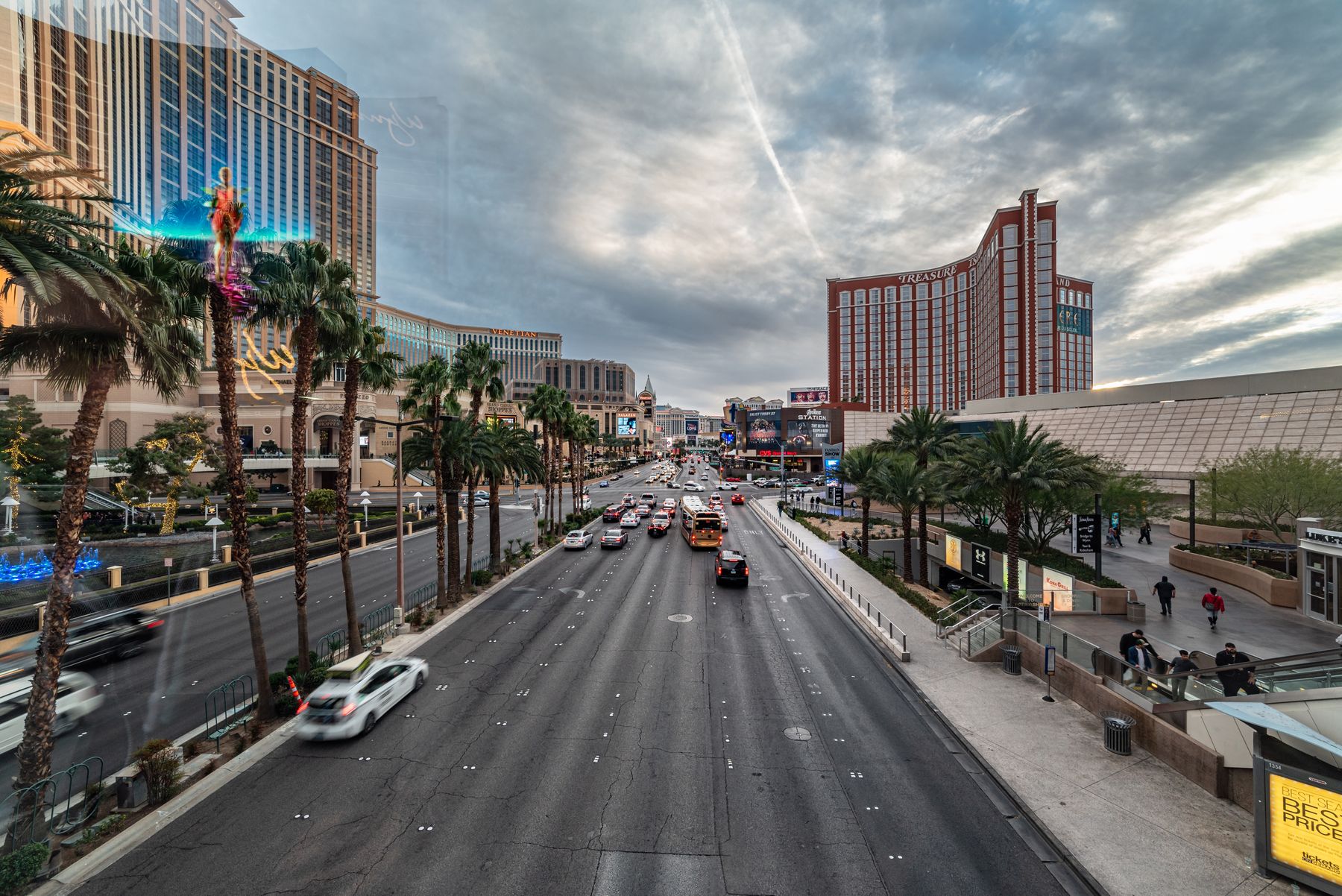
Stage one: Las Vegas to Beatty through the Amargosa Desert
Leave Las Vegas on US-95 north past the Spaghetti Bowl and let the sprawl fall away around Indian Springs, where the airfield once handled Atomic Age test pilots. From the Strip to Beatty is roughly 115 miles, a little over ninety minutes if you do not stop, but you should: Rhyolite's ghost-town ruins sit four miles west of Beatty, and Death Valley Junction's Amargosa Opera House is a further half hour on State Route 190. Fill the tank in Las Vegas, because gas between here and Tonopah is sparse and priced accordingly.
Beatty is the natural overnight, with a handful of motels and an RV park, but the better base is the town of Death Valley Junction side or a Las Vegas hotel if you want a pool and a proper dinner. Most travellers on this corridor book two nights in Las Vegas as a start and finish, using the city as a staging post. Late October through April is the season; July daytime highs in Beatty routinely top 100°F and the driving is unpleasant. Book ahead for spring weekends, when Death Valley visitors spill into town.
Stage two: Beatty to Tonopah, the long empty middle
The 90 miles from Beatty to Tonopah is the section people underestimate. There is one junction of consequence — US-95 meets State Route 267 near Scotty's Junction — and otherwise it is creosote, Joshua trees and the Nevada Test and Training Range on your right. Goldfield, 25 miles south of Tonopah, is worth an hour: the 1907 Esmeralda County courthouse and the International Car Forest, a field of painted cars planted nose-down, both sit just off the highway.
Tonopah is the best-value stop on the whole route. It has a real supermarket, a handful of historic hotels and motels clustered around the courthouse, and the Mizpah Hotel, restored and open again, is the one building I would book rather than merely admire from the street. Rooms in Tonopah run well below Las Vegas rates even in peak season. Give yourself two nights if you want to see the Tonopah Historic Mining Park and the Clown Motel's odd cemetery next door; one night if you are pushing north.
Stage three: Tonopah to Hawthorne and the Carson Basin
North of Tonopah the road straightens and the Walker River Range fills the windshield. Hawthorne, 110 miles on, is the largest town in Mineral County and home to the Hawthorne Army Depot, whose bunkers are visible from the highway. Walker Lake, just north of town, is the reward: a 60-square-mile desert lake below the Wassuk Range with a handful of pullouts and a swim beach at Sportsman's Beach on US-95's east side. It is cold, deep and startlingly blue.
Hawthorne has basic motels and a couple of diners; it is a fuel stop rather than a destination. My advice is to push on to Fallon or Yerington instead. Yerington, reached by State Route 208 west of Hawthorne, is a small farming town with a decent courthouse square and easier access to the Pine Nut Mountains. From Hawthorne to Fallon is about 65 miles; to Reno another 63 on US-50 and US-95A. The best months for Walker Lake are May, June and September, before the summer heat and after the wind.
Stage four: Fallon, Fernley and into Reno
Fallon is the last real service town before Reno and the seat of Churchill County, with the Stillwater National Wildlife Refuge and the Lahontan State Recreation Area close by. US-95A runs northwest through Fernley, where it joins I-80 for the final 30 miles into Reno. Fernley is rapidly growing and has chain motels; it is a reasonable base only if you are heading to Pyramid Lake early the next morning. Otherwise drive into Reno and stay downtown near the Truckee River or in Midtown, where the walkable restaurants are.
From Fallon to Reno is roughly 63 miles, about an hour. The route finishes as it started — on a plain, with mountains ahead — and the descent into the Truckee Meadows past the Verdi exit is the best view of the trip. Avoid this drive in December through February unless you carry chains; US-95 itself stays open, but I-80 over the Sierra and the roads around Reno can close. Spring and autumn are the sweet spots. For a Reno stay, book downtown for a first visit and Midtown if you plan to eat out.
Good to know
Questions, answered
How long does the Las Vegas to Reno drive take on US-95?
Nonstop it is around 440 miles and roughly seven hours, though most drivers break it over two days. With stops at Rhyolite, Goldfield and Walker Lake, plan on a full day plus an overnight in Tonopah or Hawthorne.
Is there gas between Las Vegas and Reno on US-95?
Yes, but it thins out. Reliable stops are Beatty, Goldfield, Tonopah, Hawthorne, Fallon and Fernley. Fill up in Las Vegas and again in Tonopah; do not pass an open station on the Beatty–Tonopah stretch assuming another will appear.
Where should I stay overnight on the US-95 route?
Tonopah is the best midpoint, with historic hotels and motels around the courthouse and the lowest rates on the drive. Beatty works for an early Death Valley start, and Fallon or Fernley suit a late arrival if you only need one night.
When is the best time of year to drive US-95 through Nevada?
April to June and September to October give mild days and cool nights. July and August bring triple-digit heat in Beatty and Tonopah, and December to February can mean snow on the passes near Reno, though US-95 itself is usually clear.
Do I need a four-wheel-drive vehicle for this route?
No. US-95 is a paved, well-maintained two-lane highway the whole way. A standard car is fine; the only reason for higher clearance is if you plan to detour onto dirt roads to ghost towns like Rhyolite or Berlin-Ichthyosaur State Park.
Is Death Valley worth a detour from Beatty?
It is, and Beatty is the closest Nevada base. The drive to Furnace Creek via Death Valley Junction is about 45 minutes. Go early in the morning, carry water, and avoid the summer months when temperatures in the valley are dangerously high.
Should I book a Las Vegas hotel before or after the drive?
Book Las Vegas first, since it is both the start and the usual return point for a loop, and weekend rates there climb quickly. Then book Tonopah or Beatty for the middle night. Reserve Reno last, as rates there are less volatile outside major events.
What should I skip on the Las Vegas to Reno drive?
Skip Fernley as a sightseeing stop and do not linger in Hawthorne beyond fuel and food. Indian Springs and Amargosa Valley offer little beyond services. Spend the time at Rhyolite, Goldfield and Walker Lake instead.
Doing good is the business: every booking through Stay Nevada funds one verified tonne of carbon removal — same room, same price, no markup.
Search stays